Sergeant at Arms
Inside the twisted, brilliant world of the Dunn family empire — where organized crime runs like a Fortune 500 company, and the next generation is already out negotiating its founders.
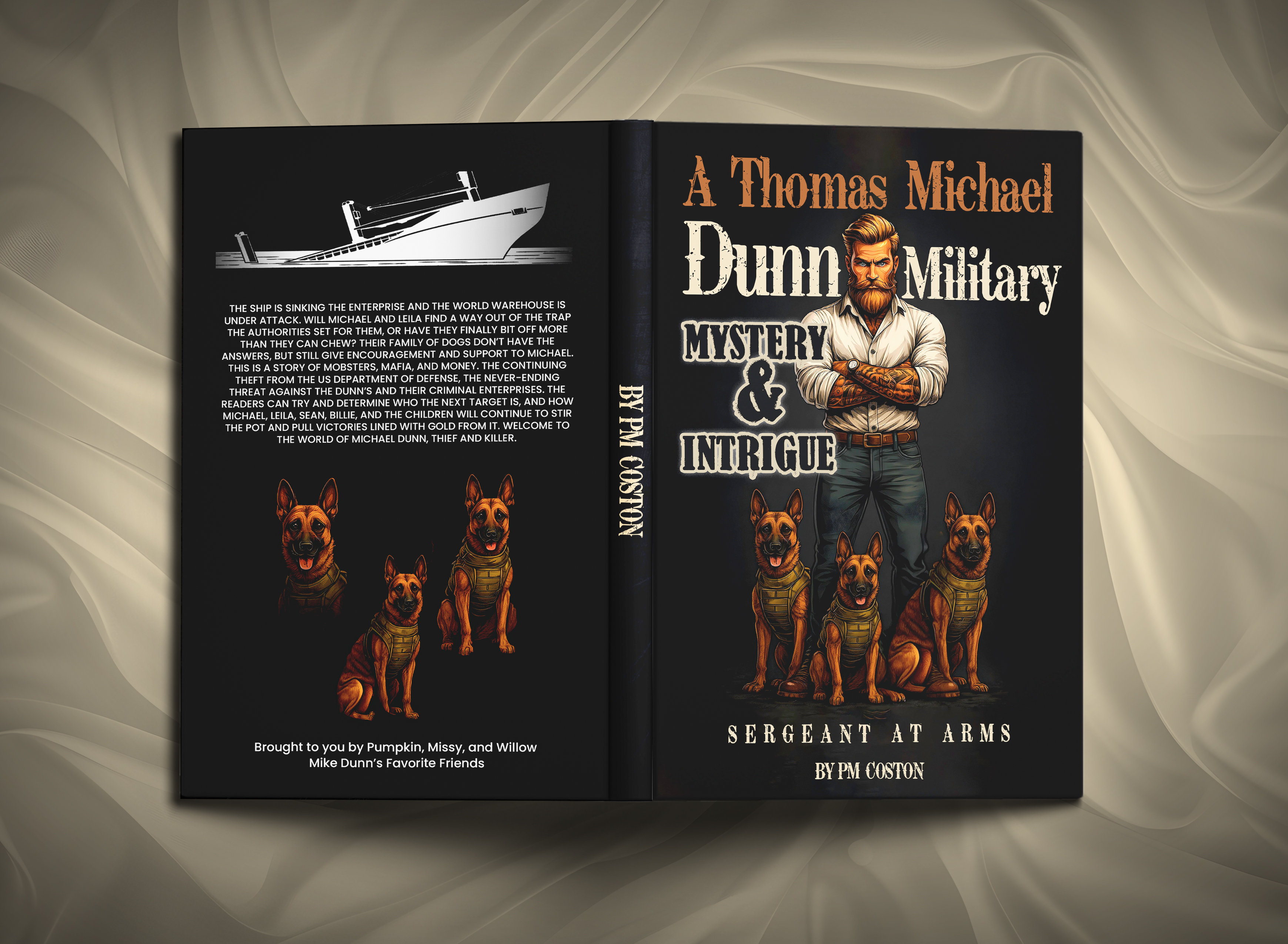
Sergeant at Arms
Inside the twisted, brilliant world of the Dunn family empire — where organized crime runs like a Fortune 500 company, and the next generation is already outnegotiating its founders.
There's a moment early in Sergeant at Arms, Book 8 in the Michael Dunn series, where a man calling himself "Robert" reaches out to Michael Dunn with a proposition too dangerous for anyone with a conscience — and too lucrative for anyone without one. He wants Dunn's crew to steal experimental military hardware from a US Army depot. He wants it done quietly. And he wants nothing in return but the satisfaction of watching a government official fall.
Dunn's answer is not "no." It's a negotiation.
That single exchange tells you everything you need to know about why this series has built such a devoted following — and why Sergeant at Arms might be the sharpest, most unsettling entry yet. This isn't a thriller about good guys chasing bad guys. It's a thriller narrated from inside the enterprise of a family that has rebranded organized crime as a business model, complete with HR policies, payroll, and a disturbingly reasonable-sounding mission statement.
A Crime Family Goes Corporate
Michael and Leila Dunn open Sergeant at Arms not as fugitives hiding in the shadows, but as executives rebuilding their brand. Living under an assumed name in Bern, Switzerland, the couple has rechristened their criminal operation "the World Warehouse" — a deliberate distancing from the old "Enterprise" name that had grown too notorious among law enforcement circles. They've even folded a working dairy farm into their cover story, endearing themselves to unsuspecting Swiss neighbors who have no idea the friendly couple down the road runs an international theft ring.
It's a wickedly clever premise, and it's played with a straight face that makes it land even harder. The Dunns aren't hiding in back alleys. They're restructuring like a Fortune 500 company that's had a PR problem — instituting team-building seminars for their "sector bosses" (now dubbed Chief Operating Officers), paying social security and unemployment taxes for their operatives, and building a corporate culture designed to keep the authorities looking the other way. It's satire with teeth, and it never once winks at the reader. The horror is in how normal it all sounds.
Michael Dunn, ever the showman, has even bought a Mercedes-Benz dealership as a legitimate front — because, as any good criminal knows, the best hiding place is right out in the open, wearing a suit and shaking hands with the local banking community.
The Deal That Changes Everything
The plot ignites when Dunn is contacted through an old, supposedly dead channel — a phone number that once belonged to a former associate, now presumed gone. The man calling himself Robert claims to have located a hidden cache of experimental combat drones: humanoid ground units capable of replacing an entire platoon of soldiers on the battlefield. He wants several of them stolen — not for resale, but to be planted in a private warehouse belonging to a Department of Defense official Robert wants publicly disgraced and impeached.
It's an offer that immediately reeks of a trap, and Dunn knows it. What follows is a tense, escalating negotiation over price, "taste" (the criminal term for a cut of the goods to resell), and risk — conducted through encrypted Dark Web channels where every word could be the one that gets the whole operation caught. When Dunn finally convenes his family around the table to weigh the job, the scene plays less like a heist movie and more like a boardroom acquisitions meeting, with Leila calling the meeting to order and Dunn's own daughter, Diane, coolly restructuring the entire deal on the spot — demanding more money, more guarantees, and better terms than her father had even thought to ask for.
It's a chilling, quietly devastating moment. That single scene sets up one of the book's most compelling threads: what happens when the next generation doesn't just inherit the empire, but out-negotiates the empress and the emperor who built it?
A Family Business With No Rulebook
What separates Sergeant at Arms from a standard crime thriller is its willingness to sit inside the discomfort of its characters rather than simply punish them for it. Leila is the operation's calculating financial mind — closing side deals on stolen cruise missiles while her husband handles logistics, ever pragmatic, ever aware that she is married to a man capable of real violence. Sean, the family's longtime fixer, handles recruitment and reconnaissance with the weary competence of a man who has done this too many times to be surprised by anything anymore — including being sent halfway around the world to scout naval storage facilities in Australia.
And then there's Michael Dunn himself: a man who has built an entire internal architecture of self-justification to avoid ever confronting what he actually is. The novel doesn't let him off the hook for this — it dissects it. Dunn doesn't lie the way ordinary people lie. He engages in something closer to self-deception at an almost neurological level, reframing every criminal act as reasonable, even righteous, before the thought fully forms in his mind. He can tell you, with complete sincerity, that stealing from the Department of Defense is a public service. He can justify the unjustifiable so fluidly that even he seems to believe it.
This is where Sergeant at Arms does something unexpected for a thriller of this kind — it pauses to interrogate its antihero's psychology, weaving in reflections on self-deception, moral rationalization, and the philosophical question of whether anyone, criminal or otherwise, truly believes they are the villain of their own story. Readers who love their thrillers fast and plotted will get the tension, the double-crosses, and the high-stakes heist planning they came for. But underneath it, there's a genuinely thoughtful meditation on how ordinary-seeming people convince themselves that wrong is right — a theme that resonates well beyond the pages of an espionage thriller.
Stakes That Reach the Pentagon — and Beyond
As the operation unfolds, the scope widens dramatically. What begins as a proposed theft from a single Army depot spirals into something much larger: negotiations to relocate stolen ground drones to a remote storage bunker on Diego Garcia, a scramble to identify which senior Pentagon officials might be persuaded — or bought — and a side deal involving stolen Russian cruise missiles sold to Saudi buyers at a staggering markup. The Dunns are no longer just thieves. They are quietly becoming power brokers in a shadow economy of military hardware, playing nations against each other while insisting, all the while, that they are simply good businesspeople meeting market demand.
It's an audacious swing, and it works because the novel keeps its focus tight on the family dynamics even as the international stakes balloon. Every decision about drones, missiles, and impeachment schemes gets filtered back through the kitchen-table politics of the Dunn household: Who gets to go on the dangerous job? Who's protecting Diane, and from what? What does it mean that a nineteen-year-old girl is now the sharpest negotiator in a criminal empire that spans continents?
A Thriller That Isn't Afraid to Get Political — Or Personal
One of the boldest choices in Sergeant at Arms is how openly it lets its characters argue about the ethics of their own criminality. This isn't a book that simply shows theft and violence and moves on. It stops to ask the harder question: if the institutions supposedly protecting us — the Pentagon, the government, the people in power — are themselves corrupt, does that make it acceptable to steal from them? Michael Dunn thinks so. He's built an entire personal philosophy around the idea that you can't con an honest man, and that any institution careless enough to leave billions in unaccounted assets lying around deserves what it gets.
The novel doesn't simply hand Dunn the moral high ground, though. It pushes back, weighing his self-serving logic against sharper philosophical counterarguments — the difference between a desperate person stealing to survive and a wealthy man stealing because he enjoys the game, the danger of letting any one person decide unilaterally which wrongs justify which further wrongs. It's a surprisingly rich vein of moral inquiry running underneath a story that could have easily coasted on heist mechanics alone, and it's part of what gives this series its staying power. You finish a chapter of tense, high-stakes negotiation over stolen weapons systems, and then you find yourself thinking about it long after you've put the book down — not because of what happens, but because of what it makes you question.
That same unflinching quality extends to the family itself. Leila's love for her husband is never portrayed as naive; she knows exactly what he is and has made her peace with it in a way that is equal parts pragmatic and unsettling. Diane's arc — a daughter being groomed, willingly and eagerly, into the family trade — carries an undertone of tragedy that the book never spells out too bluntly, trusting readers to feel the weight of it themselves. This is a family whose bonds are genuine, even loving, and that's precisely what makes their slow moral collapse so effective. There are no cartoon villains here. There are people you might recognize, making choices you hope you'd never make yourself.
Craft That Rewards Careful Readers
Beyond its themes, Sergeant at Arms shows the hallmarks of a series that has sharpened its instincts over seven prior installments. The dialogue crackles with the particular rhythm of people who trust each other completely and lie to everyone else as a matter of course. The plotting is patient — willing to let a Dark Web negotiation stretch across days of in-story time so that the reader feels the paranoia of every silence between messages — while still building toward set pieces with real momentum. And the book's structure, alternating between the family's internal deliberations and the widening web of international stakes, gives it the pacing of both a character study and a globe-spanning thriller at once.
It's also a book unafraid of texture: footnoted references, real-world detail about encrypted communications and dark-web tradecraft, and a narrative voice that occasionally steps back to comment on its characters' psychology with the dry, knowing tone of someone who has studied human nature closely enough to find it both fascinating and a little bit funny. That authorial confidence is part of what makes the Michael Dunn series feel distinct from the crowded shelf of standard thrillers — this is a saga that trusts its readers to sit with complexity, and rewards them for doing so.
Why Readers Keep Coming Back for More
Longtime followers of the Michael Dunn series will recognize the elements that have made this saga a standout in the crime-thriller space: the meticulous procedural detail of how a criminal enterprise actually launders its money and its reputation, the darkly comic tone that never undercuts the real menace simmering underneath, and a cast of characters whose loyalty to one another is somehow more unsettling than any villain a more conventional thriller could invent. Sergeant at Arms delivers all of it while pushing the family's moral unraveling further than ever before.
New readers, meanwhile, will find an entry point that works entirely on its own terms. You don't need the earlier books to feel the tension crackle across every page of a Dark Web negotiation, or to understand why a mother might calculate the profit margin on stolen missiles in the same afternoon she reassures herself that her husband could still change. The book stands as both a continuation of a beloved series and a self-contained descent into the psychology of people who have convinced themselves that crime, done well enough, is simply good business.
For readers drawn to morally complex antiheroes in the vein of prestige crime drama — families who scheme, betray, and justify in equal measure — Sergeant at Arms offers something rare: a thriller that doesn't just ask you to root against the villains, but forces you to sit, uncomfortably, inside their logic long enough to wonder how far any of us are from making the same rationalizations ourselves.
It's a bold, unflinching addition to the series — funny in places you don't expect, disturbing in places you do, and propulsive enough to keep you turning pages long after you've told yourself you'd stop for the night. Sergeant at Arms proves that the most dangerous person in the room isn't always the one holding the weapon. Sometimes, it's the one who's convinced everyone — including themselves — that they're the good guy.
Ready to step inside the World Warehouse?
Explore the full Michael Dunn series and P.M. Coston's complete catalog of novels.
Visit pmcoston.com