The Tombs of New Haven: Inside Yale’s Century-Old Secret Societies
Discover the history, architecture, and enduring mystery of Yale University's elite, century-old secret societies like Skull and Bones.
The Tombs of New Haven: Inside Yale’s Century-Old Secret Societies
Step onto Yale University’s Old Campus in the twilight hours, and you can almost feel the weight of history—and the whispers of centuries past. Behind heavy wrought-iron gates and ivy-draped brick walls lies a collegiate subculture unlike any other in America: the elite senior secret societies.
While universities nationwide feature Greek-letter fraternities, Yale’s secretive cohort operates on an entirely different plane. For nearly two centuries, these windowless sanctuaries have recruited the campus's rising stars, weaving an intricate web that bridges undergraduate life with the upper echelons of global power.
The Big Three (and Beyond)
The tradition kicked off in 1832 when William Huntington Russell and Alphonso Taft (father of the U.S. President) founded Skull and Bones. Frustrated by what they viewed as uninspired campus literary societies, they sought a tighter, more intimate circle for high-achieving seniors.
A decade later, a fierce campus rivalry birthed Scroll and Key (1842), followed eventually by Wolf’s Head (1884), Book and Snake, and roughly a dozen active groups.
What began as an insular boys' club for northeastern prep school graduates has undergone significant transformation:
- The Integration Era: Following Yale’s transition to co-education, societies slowly opened their doors, with female students integrated into the ranks by the early 1990s.
- Modern Meritocracy: Today's tap classes intentionally draw from a diverse cross-section of campus leaders, spanning varied socioeconomic, racial, and international backgrounds.
Architecture of Intrigue: The "Tombs"
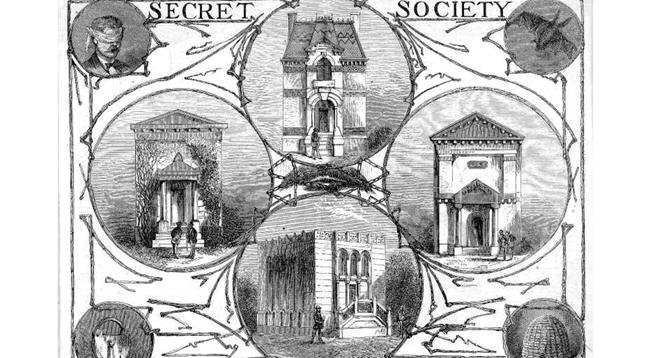
Nothing feeds public obsession quite like the physical architecture of these organizations. Locally known as "tombs," their meeting halls are architectural anomalies designed to repel prying eyes.
- Skull and Bones operates out of a windowless brownstone on High Street constructed in an imposing Egyptian Revival style, complete with heavy bronze doors.
- Scroll and Key counters with a striking Moorish-Byzantine fortress featuring alternating brick stripes and heavy masonry.
Inside these sanctuaries, members gather weekly for lifelong traditions, deep personal retrospectives, and discussions on world events. Bound by a strict code of silence, members traditionally refuse to utter the name of their society outside the building, though historical rosters for older classes are publicly accessible through Yale's Sterling Memorial Library archives.
The Drama of "Tap Day"
Membership is strictly limited to college seniors and is secured through an annual springtime ritual known historically as Tap Day.
Juniors chosen for the honor are approached in broad daylight across campus by graduating seniors, tapped firmly on the shoulder, and given a choice to accept or decline the invitation. For generations, this public spectacle brought normal campus life to a standstill, turning a private invitation into a high-stakes theatrical event.
Fact Versus Fiction: The Power Network
Because membership lists historically read like a blueprint for the American establishment—including U.S. presidents, Supreme Court justices, CIA directors, and billionaire financiers—the societies have inevitably become fertile ground for conspiracy theories.
The Reality: While the alumni network (often colloquially called "The Bonesmen" or equivalent alumni groups) undoubtedly offers formidable post-graduation connections, modern participants describe the weekly meetings less as a shadow government and more as a profound exercise in vulnerability. It provides a rare space for high-achieving students to shed their public personas and engage in candid, unfiltered dialogue.
The Myths: Urban legends regarding stolen historical artifacts, occult initiation rites, and subterranean tunnels have persisted for generations. While historical oddities and memorabilia undoubtedly line the interiors of the tombs, the true driving force behind the tradition remains human psychology: the powerful allure of exclusivity and lifelong camaraderie.
In a hyper-connected digital age where privacy feels nearly extinct, Yale’s societies stubbornly preserve their analog mystery—proving that beneath the quiet elms of New Haven, some secrets are still worth keeping.